
Sedum
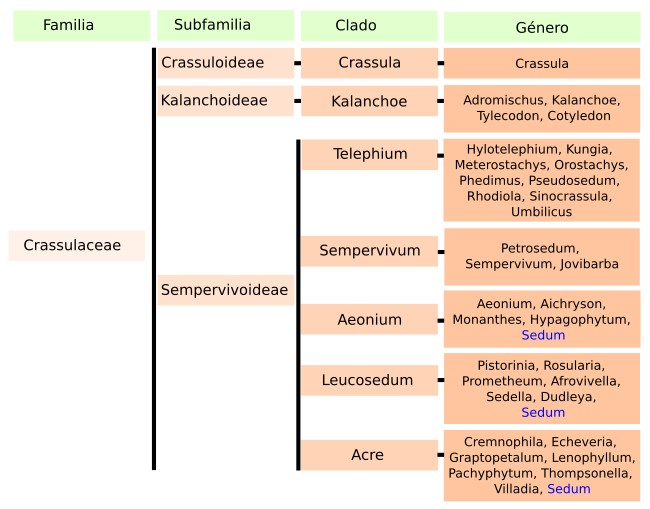
The term "Sedum" refers to "sit," highlighting the ability of these plants to grip the ground. It is probably the largest genus in the Crassulaceae family, with over 470 species. Phylogenetically, it is included in the Semepervivoideae subfamily. Sedum is a complex genus, and it is not regarded as monophyletic by several authors, meaning it is not a taxon, since there are species of Sedum in three clades of the Sempervivoideae subfamily: Acre, Leucosedum and Aeonium (Figure 1).
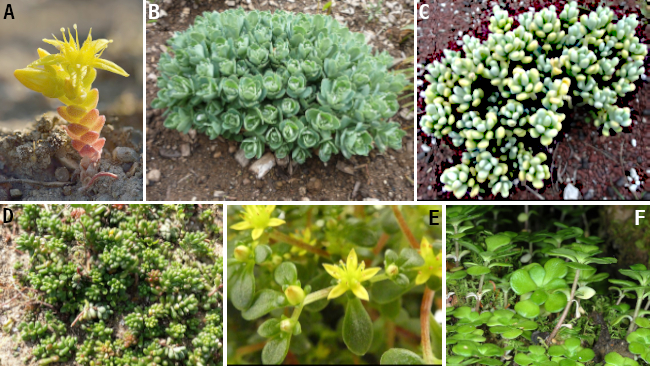
They are herbs, shrubs, or sub-shrubs, which can be perennial, biannual, or annual, and are generally fleshy (figure 2). They rarely bear trichomes. Dioic and monoic species have been found. Sedum shows a strong capability to regenerate from, for example, fallen leaves, an ability used for vegetative propagation.
Stem
The stems are upright or decumbent and highly branched; sometimes they are fasciculated or mossy-like, usually fleshy or succulent, and not commonly woody, although they may appear woody at the base. They show dichotomic branching. The diameter of the stem does not increase after secondary growth. There are reproductive stems that produce flowers and sterile stems that lack flowers. Sterile stems are always present. Rhizomes may be present.
Leaf
The leaves are often rounded, flat, or cylindrical, and entire, though sometimes toothed or incised. They are typically arranged alternately, sometimes oppositely, in whorls, or in basal rosettes. The leaves on sterile stems are tightly packed and dense, while those on fertile stems are more widely spaced. They are usually sessile and not fused at the base. In any case, the petiole is absent or poorly differentiated. They are often succulent. The veins (vascular bundles) are not conspicuous.
All leaves are amphistomatic (the stomas are found on both sides of the leaf). The subsidiary cells show thin, non-wavy but arched cell walls. Stomata may appear in clusters, with densities ranging from 20 to 60 per mm², showing variations between the abaxial and adaxial surfaces depending on the species. As with other crassulaceans, the stomatal density is lower than that found in other dicot leaves. However, although there are differences in the stomata size between species, such differencies do not happen within the same species. The pavement cells in the epidermis show wavy cell walls with different morphology depending on the species of Sedum.
Flower
The inflorescences are terminal or axillary cymes, often corymb-like. They are frequently paniculate or unilateral. The flowers may have very short pedicels or be sessile. They usually consist of many flowers. The flowers are typically hermaphroditic and pentamerous. There are 4 or 5 sepals, which are free or fused at the base, sometimes with a basal spur. There are 4 or 5 petals, which may be free or fused at the base, with entire margins. The petals are yellowish, white, pink, or reddish. The stamens are usually twice as numerous as the petals, ranging from 8 to 10, with free filaments, sometimes joined to the petals at the base. The carpels of the ovary are equal in number to the petals. They are free or slightly joined at the base. The ovules are generally numerous. The styles are as long as or shorter than the ovary. They may have oblong, square, kidney-shaped, or spatulate nectaries.
Fruit, seed
The fruit is a polyfollicle containing many seeds.
The seeds are small, ovoid to ellipsoid, smooth or papillate, and less frequently striated. They are approximately 1 mm long. The surface of the seed coat (testa) is usually irregular. Even those without trichomes do not have a smooth surface. Two factors contribute to this roughness: the papillae, which are projections of the cells on the seed coat’s surface, and the thickness of the lateral walls of these cells, which form reticulate structures. In other words, the seed’s external texture is due to the shape and size of the surface cells of the seed coat, as well as modifications of their cell walls.
In general, three types of reliefs can be distinguished: unipapillate, bipapillate, or multipapillate. Unipapillate seeds have more or less hexagonal testa cells with a single papilla or bulge. They have thickened lateral walls, giving a reticulate appearance. There are two subtypes: the reticulo-papillate (S. anglicum), and the reticulate type, where the papilla is very poorly developed (S. arenarium). In Sedum, the most common trichome is the unicellular type. Unipapillate seeds may correspond to more primitive morphologies.
Bipapillate seeds have two protrusions on the free surface of the testa cells. The cells are typically arranged in rows and lack thickened cell walls. Species in this group may have fused or unfused papillae. Binatopapillate seeds have cells that are three times as long as they are wide, with small, slender papillae. Spheropapillate seeds have two clearly visible spherical papillae with a papilla diameter similar to the cell width. For example, S. brevifolium. Costate seeds have fused papillae, both within the same cell and between adjacent cells, forming a sort of rib. The papillae may not be fused along their entire height (semicostate as in S. hirsutum), may be very thin at about 5 µm (cartacocostate as in S. caespitosum), of medium thickness with ribs 8 to 10 µm wide (laticostate as in S. hispanicum), or almost indistinguishable due to their small size (subcostate as in S. caeruleum). Sometimes the surface is covered by a substance that hide the ribs (sectocostate). Multipapillate species have cells in the testa with two or more papillae (up to 5) on their cells, as in S. selskianum. These surface features do not appear to follow a gradual pattern; that is, they seem to be characteristic of each species.
There appears to be a connection between the morphology of the testa surface and the capacity for hybridization among species. Thus, species showing testa with similar morphology hybridize more effectively than those exhibiting differing morphologies.
During macrosporogenesis, callose is deposited within the cell wall of the cells of the ovary in flower, isolating the somatic cells from the reproductive cells. When the deposition of callose is studied across different species of Sedum, a disparity of processes is observed. This observation is another piece of evidence that supports the heterogeneity within this genus of plants.
Root
The roots are fibrous and do not develop a complex root system. Rhyzomes can be present.
Habitat, distribution
Society
Some species of Sedum are good candidates to be used in green roofs. They are roofs where plants are grown as a way to dissipate heat and be more friendly with the environment. Other species show features useful for healthcare, while others are edible, such as S. aizoon in parts of Asia and Mexico. Another process where Sedum can play a role is in phytoremediation of polluted soils. In this context, S. plumbizincicola and S. aizoon can thrive in soils with high content in heavy metals. These plants extract these metals from the soil and accumulate them within their tissues.
Phylogeny
Taxonomy (NBCI)(↗): Viridiplantae; Streptophyta; Streptophytina; Embryophyta; Tracheophyta; Euphyllophyta; Spermatophyta; Magnoliopsida; Mesangiospermae; eudicotyledons; Gunneridae; Pentapetalae; Saxifragales; Crassulaceae; Sedum.
WFO (↗): Plantae; Pteridobiotina; Angiosperms; Saxifragales; Crassulaceae; Sedum.
GBIF (↗): Plantae; Tracheophyta; Magnoliopsida; Saxifragales; Crassulaceae; Sedum.
BoldSytems(↗): Tracheophyta; Magnoliopsida; Saxifragales; Crassulaceae; Sempervivoideae Sedum.
Sedum is a polyphyletic genus, with species distributed in three clades of the Sempervivoidea subfamily. About 73 % of the species is found in the Acre clade (Figure 1).
Bibliography
Espinosa del Alba CE, Mondoni A, Baizán S, Fernández-Pascual E, Jiménez-Alfaro B. 2025. Functional trade-offs and ecological correlates of seed oil traits in alpine ecosystems. Plant Biology. 27:1401-1413. DOI:10.1111/plb.70097.
Brzezicka E, Kozieradzka-Kiszkurno M. 2023. Callose deposition analysis with special emphasis on plasmodesmata ultrastructure during megasporogenesis in Sedum (Crassulaceae). Protoplasma. 261: 31-41. DOI: 10.1007/s00709-023-01879-x.
Castroviejo SC, Velayos M. 2003. Flora Ibérica. Vol V: 121-153. Real Jardín Botánico, CSIC, Madrid. (http://www.floraiberica.org/)
Ding H, Han S, Ye Y, Bi D, Zhang S, Yi R, Yang J, Wu L, Kan X. 2022. Ten Plastomes of Crassula (Crassulaceae) and phylogenetic implications. Biology. 11:179. DOI: 10.3390/biology11121779.
Jeong W.G, Sung M-W. 1985. Epidermal Structure and Stomatal Types in Some Species of Korean Crassulaceae. Korean Journal of Botany. 28: 105-118.
Messerschmid TFE, Klein JT, Kadereit G, Kadereit JW. 2020. Linnaeus’s folly – phylogeny, evolution and classification of Sedum (Crassulaceae) and Crassulaceae subfamily Sempervivoideae. Taxon. 69: 892-926. DOI: 10.1002/tax.12316.
‘t Hart H, Berendsen W. 1980. Ornamentation of the testa in Sedum (Crassulaceae). Plant Systematics and Evolution. 135: 107-117.
WFO (2025): Sedum L. Published on the Internet; http://www.worldfloraonline.org/taxon/wfo-4000034941. Accessed on: 12 Dec 2025.
Yarbrough JA. 1936. Regeneration in the foliage leaf of Sedum. American Journal of Botany. 23: 303-307.
Images's credits
Figura 2:
Sedum acre; Ivar Leidus, via Wikicommon: https://commons.wikimedia.org/wiki/File:Sedum_acre_single_-_Niitv%C3%A4lja.jpg
Sedum exterieur by Encyclauteur vía Wikicommon: https://commons.wikimedia.org/wiki/File:Sedum_exterieur.jpg
Sedum allantoides by Juan Carlos Fonseca Mata vía Wikicommons: https://commons.wikimedia.org/wiki/File:Sedum_allantoides_(Crassulaceae).jpg
Sedum album by Michel Langeveld vía Wikicommons: https://commons.wikimedia.org/wiki/File:Sedum_album_117215270.jpg
Sedum actinocarpum by 筱萱 vía Wikicommon https://commons.wikimedia.org/wiki/File:Sedum_actinocarpum.jpg
Sedum ternatum by DouglasGoldman vía Wikicommon https://commons.wikimedia.org/wiki/File:Sedum_ternatum6.jpg