
Sedum hirsutum All.
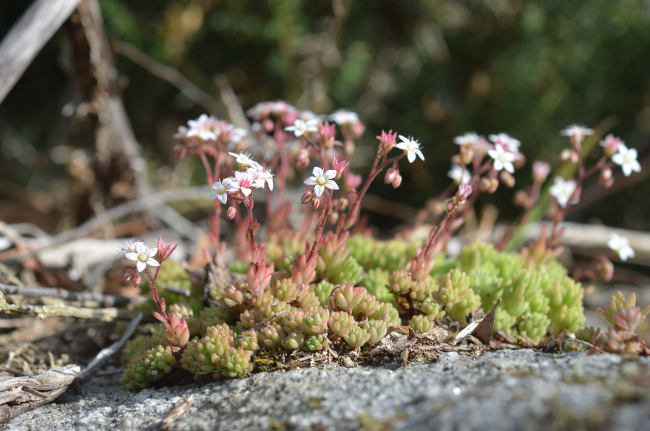
It is a perennial species with many trichomes. It grows slowly and sticky when touched. Generally, it develps into small clumps (Figure 1).
Stem
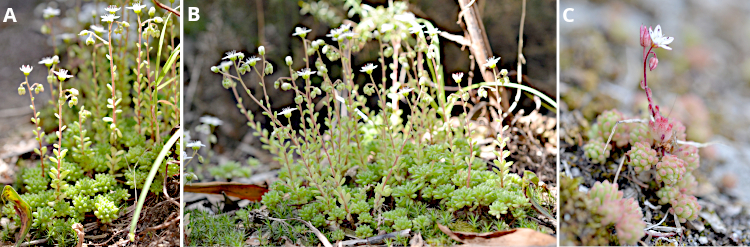
Stems are short, although they can be up to 15 cm. It typically branches at the base and develops menay leaves. There are both sterile stems and fertile stems, the latter being longer.
Leaf
The leaves are ovoid and thick, and they show a flat upper surface. They are subopposite or alternate, organize in rosettes. The color is light green to brownish. They show many trichomes. Leaves are 6 to 14 mm long and 1.5 to 5.5 mm thick. Se organizan en rosetas.
Flower
The flowers form inflorescences in panicles with few flowers. There are small and greenish bracts. They are pentamerous flowers with pedicels measuring 1.2 to 2.5 mm long. The sepals are oval and pointed. Petals are white with a reddish middle vein, fused at the base. There are 10 stamens that are shorter than the petals, with white filaments and purple, horseshoe-shaped anthers.
Fruit, seed
The seeds of the genus Sedum are about 1 mm long. The surface of the testa is irregular because its cells tend to displaying papillae. The seeds are numerous, very small, and oval. The seeds of Sedum hirsutum are called bipapillate costate, of the semiscostate subtype, regarding the structures observed on the surface of the testa. Bipapillar means that each cell of the testa bears two papillae, costate means that papillae are joined to one another and to the papillae of adjancent cells by a kind of wall, part of the papilla remains free (semicostate). These joinings form ridge-like structures, or ribs (costates) that outgrow from the surface of the seed and are oriented longitudinally. The organization of these ridges appears to be characteristic of species. The seeds show a pointed end. The flowers are pollinated by bees and butterflies.
Number of chromosomes 2n = 18, 20, 58, 60.
Sedum hirsutum easily propagates through extending thin stolons.
Raíz
They show a main root with many lateral roots. Many roots are adventitious, arising from the stems, which may emerge from the base of leaf rosettes or among the leaves.
Habitat, distribution
They are often observed growing on granitic and quartzitic rocks and on sunny walls. They thrive in rainy regions with wet soils. Sometimes, they are observed as epiphytes and live on oak bark. They are able to thrive in these areas because they develop short and very dense roots. Sedum hirsutum located at altitudes ranging from 0 to 2000 m and is distributed in southwestern regions of Europe and northern Africa. They are not common in the eastern part of Spain.
Society
While Sedum has been studied as suitable plants for green roofs, that is, covering roofs of buildings with plants, Sedum hirsutum seems to root slowly when compared to other Sedum species, and the root system is not as extensive. Thus, it shows fewer lateral roots than other species of Sedum.
Phylogeny
Taxonomy (NBCI)(↗): Viridiplantae; Streptophyta; Streptophytina; Embryophyta; Tracheophyta; Euphyllophyta; Spermatophyta; Magnoliopsida; Mesangiospermae; eudicotyledons; Gunneridae; Pentapetalae; Saxifragales; Crassulaceae; Sedum.
WFO (↗): Plantae; Pteridobiotina; Angiosperms; Saxifragales; Crassulaceae; Sedum.
GBIF (↗): Plantae; Tracheophyta; Magnoliopsida; Saxifragales; Crassulaceae; Sedum.
BoldSytems(↗): Tracheophyta; Magnoliopsida; Saxifragales; Crassulaceae; Sempervivoideae Sedum.
Bibliography
Castroviejo S, Velayos M. 1997. Sedum. Flora Ibérica. http://www.floraiberica.org/
Iglesias-Díaz MI, Martínez-Diz MP, Lamosa-Quinteiro S. 2017. Propagation of Atlantic climate native species of the genero Sedum for use in extensive green roofs. International Journal of Agriculture and Environmental Research. 3: 3190-3204.
‘t Hart H, Berendsen W. 1980. Ornamentation of the testa in Sedum (Crassulaceae). Plant Systematics and Evolution. 135: 107-117.
Stephenson R. 2008. Two Portoguese epiphytes. BioOne. 80: 100-101. DOI: 10.2985/0007-9367(2008)80[100:TPE]2.0.CO;2.