
Erica ciliaris
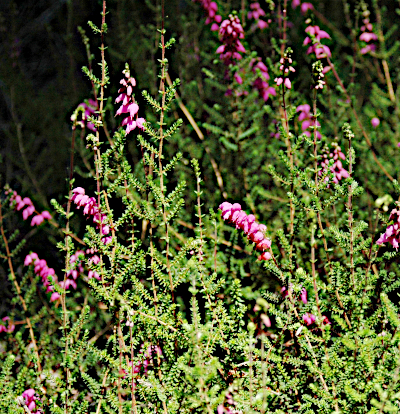
Commonly known as headers, they are perennial plants that may last for more than 10 years (Figure 1). They are from 0.2 to 0.4 m tall. The body plant is dense in branches. New branches easily emerge from the basal levels of the plant. It contains 24 chromosomes (2n).
Stem
The stem in monopodial (single stem) at germination, but it may be sympodial (several stems) in later developmental stages. The branches are short and numerous, bearing many trichomes (referred to as pubescents). The mature stems show growth rings, and 15 to 20 have been ocassionally observed. Thes easily sprouts after burning or cutting from the underground remmants.
Leaf
Leaves are arranged in whorls with 3 units (Figure 2). Leaves are 2 to 4 mm long. They are oblongated to lanceolate, with long multicellular glandular trichomes that emerge from the margin of the leaf. Other smaller trichomes are scattered over the leaf surface, except at the abaxial surface, where cells with complex projections are found. The adaxial surface of the leaf is extensive, rolling down at the margin and occupying part of the shaded side of the leaf. There is a longitudinal row of cells in the abaxial surface lacking stomata. The leaves are petiolated (0.5 mm long).
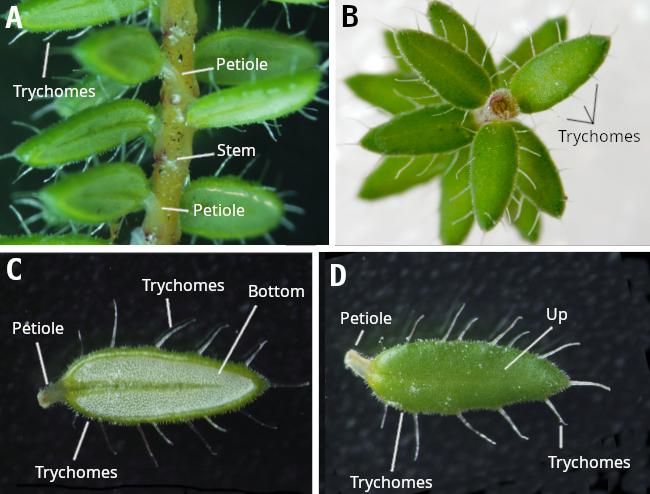
Stomata are found at the lower surface of the leaf, with guard cells slightly above the epidermal level. The surrounding epidermal cells give rise to apical extensions known as papillae. Each stoma is covered by 5 to 6 of these papillae, which arch over the stoma to form a kind of dome. There are about 92 to 164 stomata per mm2.
Flower
They show inflorescences with 15 to 45 individual flowers in a unilateral bunch, which is 15 to 125 mm long (Figure 3). Pedicels are 1 to 2 mm long. The calyx is oblongate, pubescent, and ciliate, with a corolla of about 8 to 12 mm, showing a reddish color, occasionally white. There are 8 staments with anthers. The surface of the anthers exhibits papillae but lacks appendages (Figure 4).
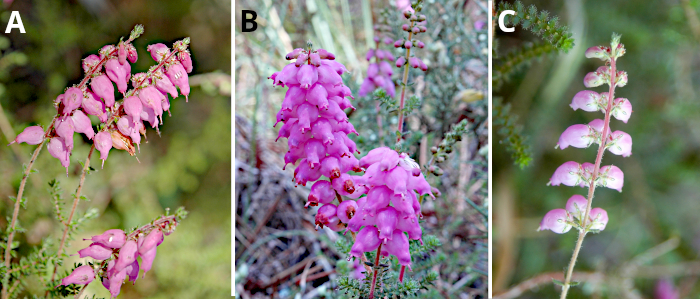

Flowering occurs from July to October. Many of the inflorescences, already withered, may last until the next blooming season. Pollination is autogamous, that is, by the wind. Erica ciliaris can hybridize with Erica tetralix.
Seed, fruit
Mature seeds are about 0.3 to 0.5 mm long and have a dry weight of around 20 µg. The fruit is a capsule, and each capsule may contain 60 to 80 seeds, that apparently are dispersed close to the mother plant.
Seeds mature from the end of August to October and are released in November. Erica ciliaris propagates easily by seeds following fires or changes in the soil.
Germination is epigeal; the root emerges from a narrow end of the seed. Cotyledons expand during the next 10 days. Germination is fast and may occur nearly after the release of the seed. However, germination is not frequent, except when the soil has been altered. They can propagate vegetatively through adventitious roots.
Root
During germination, a main root sprouts from the embryo that sends lateral roots. As the root grows, many lateral roots and adventitious emerge , that altogether form an intricate organization. Adventitious roots are produced once the shoot comes into contact with mosses or leaf debris. The older roots are dark, suberized, and lignified, while the younger ones are whitish and without root hairs. Most of the root system is distributed within about 150 mm from the soil surface, although in arid soils the roots may grow deeper.
Roots ara associated with fungi forming ericoid mycorrhizal.
Habitat and distribution
Erica ciliaris is present in communities of heathers and in swamps. They are abundant in flat, wet, and poorly drained regions. Plants often localize apart from each other. They inhabit areas from the sea level up to an altitude of 1800 m. It thrives in soils with a pH lower than 5.6. Erica ciliaris is distributed from North Africa and Western Europe up to Ireland. It is regarded as rare in the British Isles.
Society
Phylogeny
Taxonomy (NBCI)(↗): Viridiplantae; Streptophyta; Streptophytina; Embryophyta; Tracheophyta; Euphyllophyta; Spermatophyta; Magnoliopsida; Mesangiospermae; eudicotyledons; Gunneridae; Pentapetalae; asterids; Ericales; Ericaceae; Ericoideae; Ericeae; Erica.
WFO (↗): Pteridobiotina; Angiosperms; Ericales; Ericaceae; Ericoideae; Erica.
BoldSytems(↗): Tracheophyta; Magnoliopsida; Ericales; Ericaceae; Ericoideae; Erica.
GBIF (↗): Tracheophyta; Magnoliopsida; Ericales; Ericaceae; Erica.
Royal Botanic Gardens. Plant of the World online (↗) : Plantae; Streptophyta; Equisetopsida; Magnoliidae; Ericales; Ericaceae; Erica.
Bibliografía
Castroviejo S, Aedo C, Gómez Campo C, Laínz M, Montserrat P. Morales R, Muñoz Garmendia F, Nieto Feliner G, Rico R, Talavera S, Villar L. Colaboradoras: Navarro C & Fernández Arias M.ª I.; Vol. IV. Cruciferae-Monotropaceae 1993. Flora Ibérica. Madrid : Real Jardín Botánico, C.S.I.C. http://www.floraiberica.org.
Muñoz A, García-Duro J, Álvarez R, Pesqueira XM, Reyes O. Casal M. 2012. Structure and diversity of Erica ciliaris and Erica tetralix heathlands at different successional stages after cutting. Journal of Environmental Management 94: 34e40. DOI: 10.1016/j.jenvman.2011.08.006.
Rose RJ, Bannister P, Chapman SB. Erica ciliaris L. Journal of Ecology. 84: 617-628.